
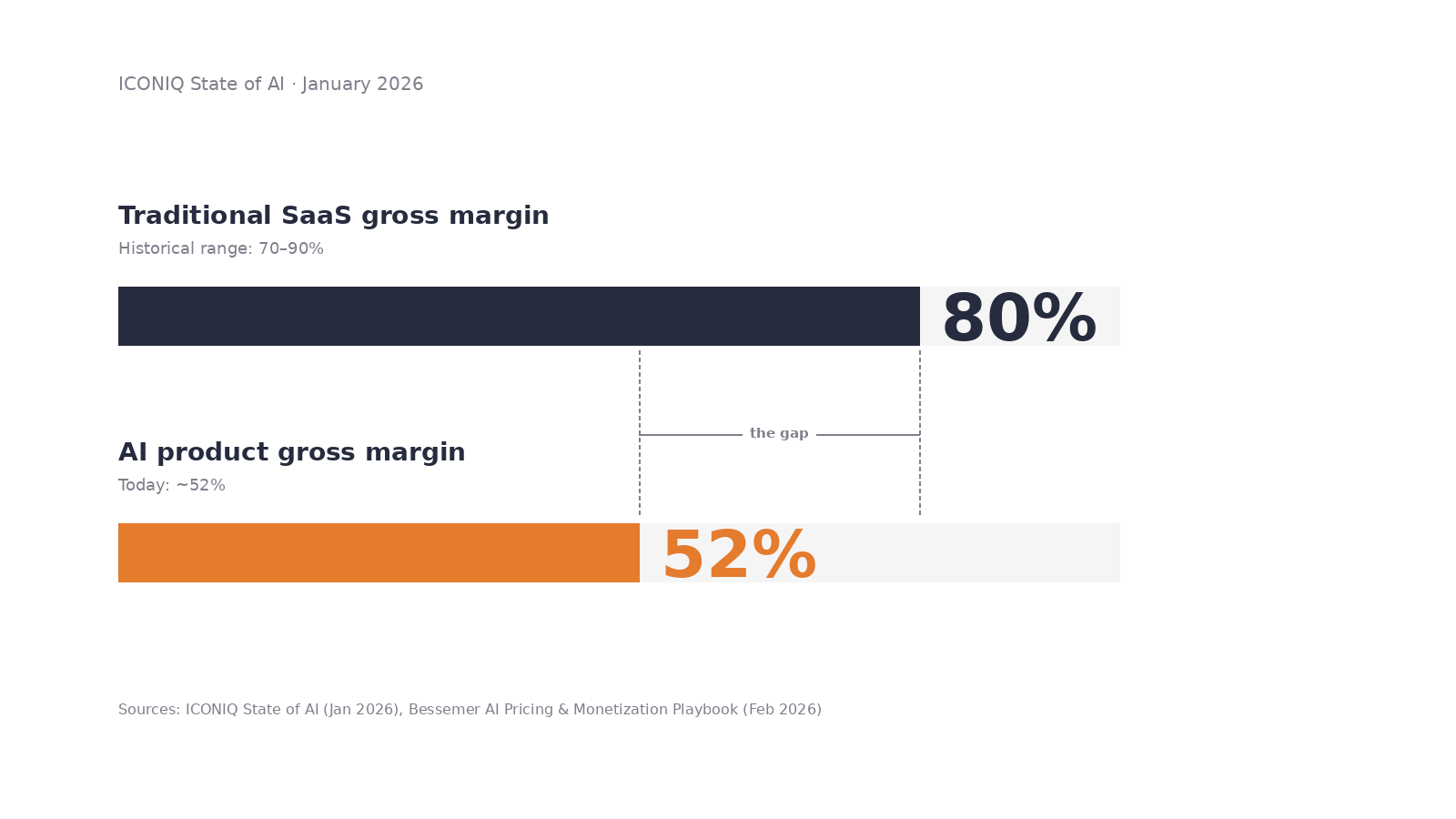
AI product gross margins now average around 52%, against the 70–90% SaaS finance teams have historically modeled. Most companies can't explain the gap.
There is a question landing in finance offices at a growing number of companies right now: what is our real margin on AI? It sounds like a simple number to produce. It isn't.
AI features carry real per-call costs that seat-based software never did. Every user query, every agent action, every API call runs a meter. That changes the fundamental economics of the products your company builds, and it changes them permanently.
According to ICONIQ Capital's January 2026 State of AI report, AI product gross margins now average around 52% across the industry, compared to the 70–90% that SaaS finance teams have historically modeled. Inference alone consumes roughly 23% of revenue at scaling-stage AI B2B companies. The gap is structural and it is widening.
Bessemer Venture Partners puts it plainly in their AI Pricing and Monetization Playbook: AI economics are fundamentally different from SaaS. COGS matter again. Every AI query incurs real compute costs, and companies see 50–60% gross margins versus 80–90% for SaaS.
The visibility problem compounds it. Engineering teams have access to usage logs and API data, but token counts do not roll up naturally into the financial categories finance teams use. Your AI providers send one invoice per service, with no cost breakdown by product line, customer, or feature. Most companies are running two, three, or four providers simultaneously, so even provider-native dashboards only show part of the picture.
Deloitte's January 2026 tokenomics analysis makes the risk explicit: packaged AI solutions like Agentforce, ServiceNow Copilot, and Workday AI abstract tokens entirely. Leaders see a predictable subscription fee but have no transparency into what is actually being consumed underneath it. Without early visibility, CFOs get forced into reactive decisions after token volumes are already committed.
Evan Goldstein, CFO of Seismic, captured the shift plainly in Fortune's December 2025 CFO roundup: "The era of buying AI for AI's sake is over. CFOs will require clarity on how AI is tied to business outcomes like improved efficiency, productivity, or sustainable growth."
For a CFO, this means making pricing decisions, customer profitability calls, and board presentations without reliable underlying data. That is a level of uncertainty most finance leaders would not accept in any other cost category.
The solution is not asking engineering to produce better reports. It is connecting AI usage data to financial systems in a way that produces the answer rather than the raw analysis. Finance teams need to see which products are profitable, which customers drive disproportionate cost, and what the trend looks like going into next quarter.
AI costs are not a temporary line item. Companies that build financial visibility now will make better pricing decisions, catch margin compression earlier, and walk into board meetings with numbers they can defend.